
Children Who Swipe… But Don’t Write: The Silent Risk Affecting Their Brain

Bilingual Edutainment / Mili & Molo Blog #2
How excessive screen use is weakening children’s motor and cognitive development… and what we can do about it today
In recent years, we have witnessed a profound shift in how children interact with the world. We moved from pencils, crayons, and paper… to screens, keyboards, and finger swipes.
While technology has brought many benefits, it has also raised growing concerns in fields such as neurology, child psychology, and developmental medicine:
Children are writing less… and it is affecting their brains more than we realize.
The child’s brain needs movement to learn
From a neurological perspective, learning is not just a mental process… it is also physical.
When a child writes by hand:
- Multiple areas of the brain are activated at once
- Hand-eye coordination is strengthened
- Fine motor skills are developed
- Memory and comprehension are reinforced
Writing is not just about forming letters. It is a complete integration of body and mind.
Research in neuroscience has shown that children who practice handwriting retain information more effectively, develop stronger attention skills, and build essential neural connections for learning.
What’s happening today with screens?
The problem is not technology itself… it’s replacement.
Today, many children touch screens but don’t trace lines, consume content but don’t create, and click responses but don’t structure ideas.
The movement required by screens is minimal and repetitive. There is no resistance, no precision, no real motor construction.
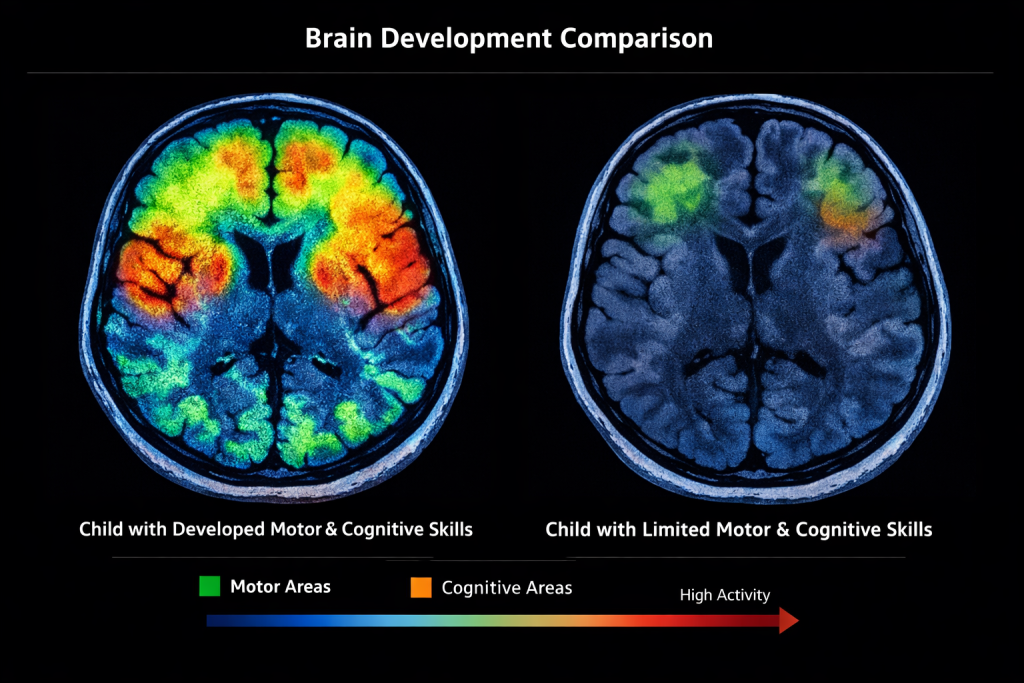
From a developmental psychology standpoint, this leads to delays in fine motor skills, difficulties with future writing, reduced attention span, and challenges in organizing thoughts.
Writing: the foundation of psychomotor development
Psychomotor development involves the integration of movement (motor), thinking (cognitive), and emotion (affective).
When a child does not properly develop writing skills:
- Coordination is affected — Basic tasks like cutting, drawing, or even buttoning can become difficult.
- The brain builds fewer deep connections — Handwriting strengthens neural pathways that screens do not activate in the same way.
- Expression becomes limited — Writing helps organize thoughts. Without it, thinking can become more superficial.
- Academic independence weakens — Writing remains essential in school and in life.
It’s not about eliminating technology… it’s about balance

The solution is not to remove screens. It is to reintroduce real, physical, and creative experiences into a child’s life.
The developing brain needs to touch, trace, draw, repeat, and create. It needs to make mistakes on paper… in order to learn.
Purposeful technology: the smart balance
At Mili & Molo, we understand that technology is part of today’s world… and we are not against it. In fact, we also use digital tools, videobooks, and screen-based content as part of the learning experience.
But there is one key difference: We don’t replace what is essential… we complement it.
Our approach is based on balance: screens to motivate, introduce, and reinforce concepts — and hands-on activities to develop motor skills and solidify learning.
Because real development happens when a child sees… but also does. Listens… but also creates. Learns… but also experiences with their hands.
A simple tool… with a powerful impact
Mili & Molo resources are created with a clear purpose: to stimulate fine motor skills, develop cognitive abilities step by step, encourage writing in a fun and engaging way, and integrate bilingual learning while children create.
They are not just books. They are development tools. Each activity is designed for the child to use their hands, activate their mind, and connect naturally with learning.
A necessary reflection for parents and educators
The question is not whether children should use technology.
The real question is: Are we making sure they first develop the skills their brain needs to grow properly?
Because a child who does not write… does not just lose a skill. They lose a fundamental part of their development.
A small change… that transforms the future
Going back to paper is not going backward. It is moving forward with intention.
Making time for writing, tracing, and creative activities strengthens the brain, improves learning, and builds a solid foundation for life.
Give your child more than entertainment. Give them development, tools, and real opportunities to grow.
Discover Mili & Molo materials and guide your child through the most important process of all: learning… using their hands, their mind, and their heart.